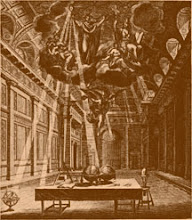
When our Founding Fathers, many of whom were prominent masons, started drafting this countrie's organizational structure, they used their current knowledge of how Freemasonry was structured, to give them an idea of where to go with this country. Before the revolution, this country was 13 colonies; each colony had its own masonry, many with their own Grand Lodge established. Our founding fathers looked at this and figured if it can work for our masonry, it can work for our country.
As our country grew, this same mentality continued to be applied to both freemasonry and the states. Each state had the ability to determine its own laws, its own regulations, and its own rules of settlement, as long as it applied to the government's basic outlining of how a state should operate. Each Grand Lodge that was established also was given the right to govern its own jurisdiction by its own bylaws, rules, and regulations, as long as it adhered to the landmarks which its brother Grand Lodges adhered to. This also gave rise to enhanced understanding of regularity and recognition. As each Grand Lodge must have been established through a regular vote of the majority of masons in the state, this kept the bonds between the states strong.
It wasn't until after the Civil War that the government took control of a large portion of the rights that states had and in essence the states lost that freedom which was intended to always been had, by our Founders. This of course had no effect on the Grand Lodge system of today, as the Grand Lodges continued to not have a governing body over them.
Thus, one can see that today's Grand Lodge system was and is the ideals of our Forefathers, the ones who went this way before us, and it works as well as any establishment can. No single Grand Lodge should have say over the operations of any other Grand Lodge; nor should they interfere with the operations of any other Grand Lodge, as it is not their place nor right to do so.
Our Founding Father's dream lives on today, not through our government, but through our Freemasonry.
Friday, March 7, 2008
Essay on The Architecture of American Freemasonry, by Bro. Justin Robinson


Wednesday, January 16, 2008
Guest Commentator: Pride in My Freemasonry, by "The Hammer"

I believe that the Craft of Ancient Freemasonry is the most important fraternity ever to appear in
My transformation came about in the last 3 years, after recovering from a tumultuous 2 years as Master, struggling to keep my Lodge with a history of over two hundred years together, and pruning some poisoned branches from the tree. I had some time to reflect upon the meaning of the words which compose our Masonic ritual. I learned, studied and in time, understood. What finally struck me like a bolt of lightning was the practical wisdom contained in Freemasonry. Masons believe in God, the immortality of the soul and the paramount importance of good character. We really are builders who believe that if we construct lives of good character, the Supreme Architect of the Universe will reward us with "a glorious immortality" for our souls. To all regular Freemasons this expresses profound truth.
Indeed, as a fraternity, we do have our secrets--but it is these very secrets which reveal to us the tenets of our Craft. In turn, these tenets set the standard of good character by which we live and display to the world as how we conduct ourselves as Freemasons. How well we accomplish this determines the success of the fraternity.
What are the tenets of Freemasonry? There are many, but here are a few examples, which are stated clearly in the Third Degree.
• We must not have two personalities--one for private and another for public.
• We must treat women the same way we want other men to treat our sisters.
• We must use the same language before women as we do before men.
• We must make the best and the most of ourselves.
• Above all, we are told to make sure "others know always that a gentleman stands before them."
I'll bet that George Washington lived by our tenets. Today, his life is known throughout much of the world. Why? He lived it as a Freemason. I am certain he demanded respect from his neighbor, just as I'll bet he first earned his neighbor's respect. There was nothing more intolerable in his sight than the letting down of himself to a lower level. He must have bid men come up to him, refusing to descend a single step to them, or he would never have been America's first and greatest leader--the man whom this country still reveres today, 200 years after his death; the great Freemason, who led this country through its struggle for independence.
The more I observe the world and study history, the more I learn about our beloved Craft, the more I am convinced that this Nation is the great country that it is because many of its original thinkers, so many of its first serious citizens were Freemasons. Thomas Jefferson, John Adams and John Carroll may not have been Freemasons, but they conversed with George Washington, Benjamin Franklin, John Hancock, Robert Livingston and others who were Freemasons. And the Freemasons’ influence "passing through and to those whom that circle may surround" refined and shaped the path that our Founding Fathers chose.
Think about it: just because not all of
Pride in Freemasonry is really what this is all about. Pride in being a member of the Craft, expressed by us as individuals to all men by our actions cannot help but attract good men to our fraternity. By making the most and best of ourselves, each and every one of us will be doing the most and best for our families, our communities, our country and Freemasonry.
Used by permission of the author.