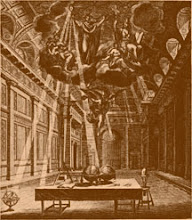
When our Founding Fathers, many of whom were prominent masons, started drafting this countrie's organizational structure, they used their current knowledge of how Freemasonry was structured, to give them an idea of where to go with this country. Before the revolution, this country was 13 colonies; each colony had its own masonry, many with their own Grand Lodge established. Our founding fathers looked at this and figured if it can work for our masonry, it can work for our country.
As our country grew, this same mentality continued to be applied to both freemasonry and the states. Each state had the ability to determine its own laws, its own regulations, and its own rules of settlement, as long as it applied to the government's basic outlining of how a state should operate. Each Grand Lodge that was established also was given the right to govern its own jurisdiction by its own bylaws, rules, and regulations, as long as it adhered to the landmarks which its brother Grand Lodges adhered to. This also gave rise to enhanced understanding of regularity and recognition. As each Grand Lodge must have been established through a regular vote of the majority of masons in the state, this kept the bonds between the states strong.
It wasn't until after the Civil War that the government took control of a large portion of the rights that states had and in essence the states lost that freedom which was intended to always been had, by our Founders. This of course had no effect on the Grand Lodge system of today, as the Grand Lodges continued to not have a governing body over them.
Thus, one can see that today's Grand Lodge system was and is the ideals of our Forefathers, the ones who went this way before us, and it works as well as any establishment can. No single Grand Lodge should have say over the operations of any other Grand Lodge; nor should they interfere with the operations of any other Grand Lodge, as it is not their place nor right to do so.
Our Founding Father's dream lives on today, not through our government, but through our Freemasonry.
Friday, March 7, 2008
Essay on The Architecture of American Freemasonry, by Bro. Justin Robinson


Sunday, January 27, 2008
The Problem of Fraternity, By Angel Millar (Bro.)

With the decline in membership, and the loss of revenue from dues, in recent years Grand Lodges have become especially alarmed. They have often committed vast amounts of capital to homes for the elderly, and these can’t simply be abandoned. While they have encouraged Lodges to initiate more and more men, and to make the initiation process easier, they have not instituted policies that – to use the cold language of the modern age – give value for money. They have been reactionary rather than pro-active; and they have largely promoted the Craft in a way that appealed to them when they were young men, or, perhaps, that appealed to their fathers, who introduced them to the Lodge in the first place. Consequently new members often disappear after a short while.
But the situation cannot be entirely blamed on the various Grand Lodges and the elder statesmen that populate them either. Simply, put, they cannot legislate initiative. Freemasonry is, and has always been, a voluntary society, and has always required its members volunteering their talents, knowledge and understanding. In the eighteenth century when it was enormously popular Freemasonry was characterized by creative zeal. Men painted their own Masonic aprons, or their wives sowed and embroidered them. They made the tools for the Lodge, painted tracing boards, or drew illustrations directly onto the floor in chalk. Moreover, Freemasons discussed and even argued over Freemasonry. They delivered lectures. They ate, drank, sang, and even put on Masonic plays together. It deserved the name, “the Craft.”
There is another important change. If in the eighteenth century the philosophical and so-called “esoteric Freemasons” were particularly active and vocal – writing books, lecturing, creating Rites and Degrees (even if these were frowned upon) – today they a silent, and one might say a rather guarded group. Such Freemasons are, typically, aware of the esoteric tradition generally (the Hermetic Order of the Golden Dawn, alchemy, Cabala, etc.), and, as such, they may be more knowledgeable about related traditions than the average Brother. They have something to contribute to the Lodge, but, instead, it seems they want to hoard their knowledge, as if it is a finite resource which will run dry if shared. Some of them have expressed to me that their Grand Lodge may disapprove or even punish them in some undefined way if they hear of their interests.
No doubt I am an esoteric Mason of sorts. I have given talks on the Golden Rosicrucians in Lodge, and in May my book, ‘The Forest of Symbols,’ specifically charting the impact of Freemasonry on the Western Esoteric Tradition, will be published. So far I have encountered no hostility from the Grand Lodges, and have even been praised by many of the members of the Grand Line, and asked to do more. I am not trying to inflate my importance, but simply to point out that the fears of esoteric Freemasons are probably not justified. Most Brothers did not join the Craft because of fraternity or charity. To differing degrees most have an interest in philosophy, symbols, mythology, esotericism, etc., and all have a burning interest in the Craft itself.
Grand Lodges might be faulted for not encouraging a lively intellectual tradition within Freemasonry, but those of a century ago were no better than those of today. Indeed, one might cite positive examples of our own time, such as the Grand Lodge of New York’s publication of a manual for Masters of Lodges, containing history, lectures, and even a few texts from the eighteenth century, and the Grand Lodge of British Columbia and Yukon posting of an extensive list of papers on Freemasonry and esotericism on its site. In Europe, where Freemasonry is flourishing, Entered Apprentices are expected to give lectures on the Craft. It’s a good practice. New Brothers get to learn a lot in a short time, and Lodges ensure that they have knowledgeable members who are getting the most out of Lodge, and who are able to give the most back, and mentor younger Brothers, or simply answer their questions intelligently, when the time comes.
Brothers in English-speaking countries may bewail the promotion of the Craft as a fraternity-cum-charity (certainly I do), especially when it is currently attracting global attention as a Mystery tradition. But unless individual Freemasons as well as Lodges take the initiative, go out on a limb, and give talks on the Craft, and cultivate the kind of enthusiasm for Freemasonry inside the Lode that one regularly experiences with Brothers outside of the Lodge, then Grand Lodges will be unable to promote it as a Mystery tradition, or a school of philosophy or esotericism, etc. Masters and Officers of a Lodge are responsible for encouraging discussion of Freemasonry in Lodge, but Brothers who are philosophically or esoterically inclined are equally responsible. Lodges need to be the one place a man can go to learn about Freemasonry. They have to be places of ‘mutual education,’ not entertainment. Only in this way will it remain a rewarding experience for men of our time.
There may be some good news in this regard. The internet – love or hate it – is connecting enthusiastic Masons with one another, and it is becoming increasingly clear that the interest that Freemasonry generates really is in its rituals, symbols, etc., not especially in its charitable works, wonderful though they may be. Brothers are gaining mutual support outside the Lodge, and they are getting quite a bit of information too. However, if it is not to end up comparable to the Lodge dinner, then those who are active online need to be active in Lodge. An article for an online Masonic forum needs to indicate a talk given in Lodge. A comment in a blog needs to suggest a Mason that gives sound advice to younger Brothers. In effect, from Grand Master all the way down to the Entered Apprentice, we are going to have to reinvigorate the Craft ourselves, by bringing it back into the Lodge. We need not worry that every word of a lecture is delivered like a professional speaker, or every talk crafted like the work of a historian or philosopher. We are members of the Craft, not the art. We have to expect the rough with the smooth, but, like online communities, members of Lodges need to share what skills and understanding they have.
used by permission